


AllSides
3.4172.00 Reviews
App Specs
- Version
- 2.2.2
- Updated On
- License
- Free
- Downloads
- 50,000+
- Developer
- AllSides Technologies, Inc
- Categories
- News & Magazines
- Platform
- Android
Screenshots
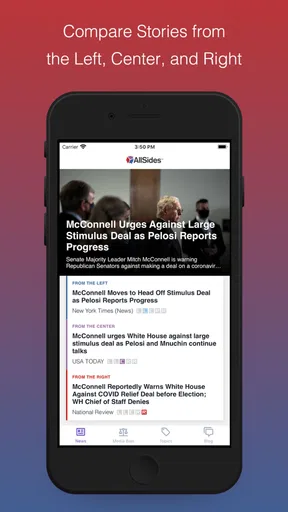
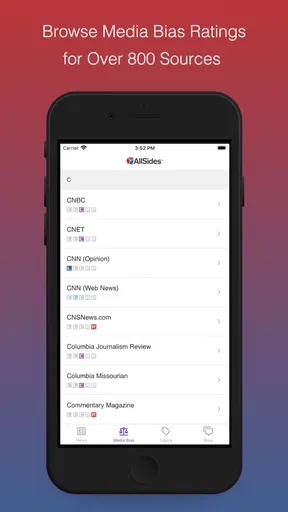
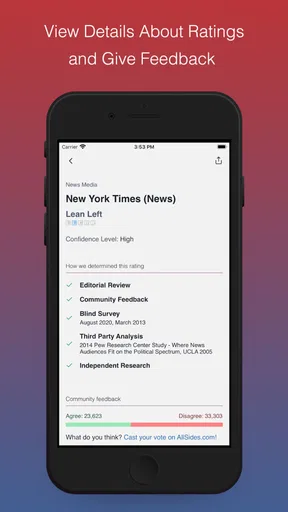
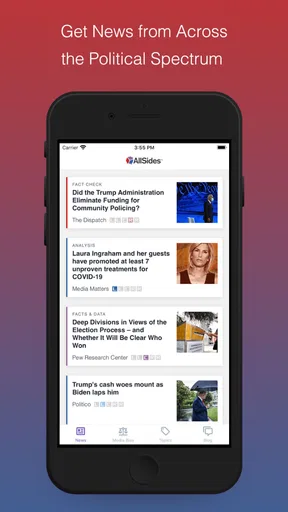
 Analysis by AppCompare
I installed AllSides because I wanted a calmer way to compare news coverage instead of opening several tabs and guessing why two headlines felt so different. This free news and magazines app, made by AllSides Technologies, Inc, is built around media-bias ratings and a broader view of current events. Its main value is not simply showing more articles; it is encouraging me to notice how the same subject can be presented from different editorial angles.
That distinction matters. I would not use it as my only news source, and I would not treat a bias label as a final judgment about whether an article is accurate. I see it as a reading aid: a place to start when I want to compare framing, spot missing context, and slow down before accepting the first version of a story that appears in my feed.
The app is free, aimed at users aged 10 and over, and supports Android devices running version 7.0 or later. It launched on November 2, 2020, and the current version is 2.2.2. With more than 50K installs, it has a smaller footprint than the biggest general news services, but that is not necessarily a weakness for this particular purpose. The experience feels focused on media perspective rather than trying to become an all-purpose replacement for every newspaper, broadcaster, or breaking-news alert.
Where the reading experience can become confusing
The first thing I had to understand was what AllSides is actually helping me compare. It is not a guarantee that every viewpoint is represented equally in every subject, nor is it a substitute for reading the full article. The useful question is not “Which side is correct?” but “How does this source frame the story, and what might another source emphasize differently?” Once I approached it that way, the app became much more useful.
A common point of friction is expecting a single neutral answer. Media-bias ratings can organize a comparison, but they do not remove the need for judgment. Two outlets may use different language while still reporting the same basic event, or they may disagree because they select different facts as important. I found that the ratings work best as a prompt to investigate, not as a shortcut that tells me which article to trust.
Another possible stumbling block is the difference between a headline and the underlying report. Headlines are designed to make me open a story, so comparing only those short lines can exaggerate the contrast between outlets. My better routine was to read enough of each article to identify the central claim, the evidence being used, and the details left in the background. That takes longer, but it turns the app from a quick label-checker into a practical media-literacy tool.
The relatively modest average rating of 3.4, based on over 300 ratings and more than 170 written reviews, suggests that the experience will not satisfy everyone equally. I can understand why. People looking for a conventional news feed may find the emphasis on comparison less direct, while readers who already have a preferred outlet may see little reason to examine alternative framing. The app has a clearer purpose for curious readers than for people who simply want the fastest headline.
Worth Reading Before You Choose

EA SPORTS FC Mobile 26 Is a Bigger Football Game, but It Takes Time

Flipboard Shows What News Apps Must Do Beyond the Feed

Switching to Android Auto Means Rethinking Your Driving Routine

Google Calendar Makes a Crowded Week Easier to Manage

Ludo King Makes the Most of the Minutes Between Plans

Baby Panda World Brings Quick Play to Modern Phones, but Its Game Library Feels Busy
What I would clarify before blaming the app
If a story seems missing, delayed, or different from what I expected, I first check whether I am searching for a very specific local event or a rapidly changing report. A media-comparison service is most helpful when there is enough coverage to compare. A developing story may have uneven reporting, changing headlines, or incomplete facts across sources. That can make the app look inconsistent when the real issue is that the news itself is still moving.
I also avoid judging the whole service from one article. A single story can be unusually technical, opinion-heavy, or poorly matched to the subject I searched for. I look at several topics before deciding whether the organization of the app works for me. This is especially important because the app’s central idea is comparative: its value appears over repeated use, not necessarily in one isolated headline.
For readers who are worried about age suitability, the Everyone 10+ rating is a useful general guide, but news topics can still vary in seriousness. I would not hand it to a young child without checking what is being read. The rating does not change the fact that current events may include upsetting subjects, strong political disagreement, or complicated social issues.
Setup checks that prevent unnecessary frustration
Before using AllSides regularly, I would confirm that the Android device is running at least version 7.0. That is a simple check, but it matters on older phones and tablets. If the app will not install or behaves unexpectedly, the operating-system requirement is one of the first things I would verify rather than assuming the problem is with the news content.
I would also make sure the device has a stable connection before judging loading performance. News content depends on current material, so a weak connection can create a confusing experience: a headline may appear while the article or surrounding context takes longer to load. Switching between a reliable Wi-Fi connection and mobile data can help identify whether the difficulty is local to the device or related to the connection.
Because the app is free, I would not expect a payment step to be necessary for basic access. That makes it easy to try without committing to a subscription. Still, “free” does not mean every part of the experience will feel frictionless. The practical cost is attention: comparing sources takes more time than scrolling through one familiar feed, and that trade-off is central to whether this app suits you.
My most useful setup habit was deciding what I wanted from the app before opening it. If I wanted a quick update during a busy morning, a conventional breaking-news app might be more efficient. If I wanted to understand why coverage differed, AllSides made more sense. Defining that purpose prevented me from treating it as a replacement for every other news tool.
I would also begin with subjects I already understand reasonably well. Familiar topics make it easier to notice differences in wording, emphasis, and omitted context. Starting with a complicated story I know nothing about can make the ratings feel more authoritative than they should. After learning how the comparison works, I could apply it more carefully to unfamiliar subjects.
A practical way to read across viewpoints
My preferred workflow is to choose one event, examine the available perspectives, and write down the shared facts before focusing on disagreement. I look for details that appear across multiple reports, then separate those from interpretation, prediction, or commentary. This small habit is more valuable than simply counting how many sources appear on one side or another.
I also pay attention to the type of language used. Words that suggest blame, urgency, certainty, or suspicion can shape my reaction before I reach the evidence. Comparing those choices is one of the strongest reasons to use AllSides. It helps me notice that bias is not limited to an obvious opinion column; it can also appear through story selection, headline emphasis, and the order in which information is presented.
A less obvious benefit is that the app can reveal when my own reading habits are narrow. If I regularly agree with one style of coverage, the comparison may feel uncomfortable at first. I treat that discomfort as a signal to inspect my assumptions, not as proof that the alternative source is automatically better. This makes the app useful for readers who want to test their information routine rather than simply confirm it.
Recovering when a normal session goes wrong
If the app stops showing fresh material, I would begin with ordinary checks: confirm the connection, close and reopen the app, and try again later. I would avoid repeatedly tapping the same control, since that can make it harder to tell whether the problem is loading, a temporary interruption, or an article-specific issue. The goal is to isolate one possible cause at a time.
If one article fails while other material remains available, I would treat that as a problem with that particular item or its source rather than evidence that the entire app is unusable. I could continue comparing another subject and return later. That approach is especially sensible with news, where an external page may change or become temporarily unavailable independently of the app that points me toward it.
When the app feels slow after an update or on an older device, I would check the operating-system requirement again and restart the device before making a stronger judgment. I would also avoid assuming that a slower page means the information is wrong. Performance and editorial quality are separate questions, and mixing them can lead to an unfair assessment.
For a reading workflow that has been interrupted, I would keep a simple note of the topic and the sources I had already checked. That prevents me from starting over and helps me remember which points were shared and which were disputed. It is a small workaround, but it makes the comparison process more deliberate and reduces the temptation to settle for the first headline that loads.
When the app is not the best tool
AllSides is not my first choice for minute-by-minute alerts, specialist reporting, or a deep archive of one publication. If I need detailed financial coverage, local reporting, or a technical investigation, I would go directly to a publication with expertise in that area. The app can help me compare framing, but comparison does not replace subject knowledge, original documents, or a reporter’s full explanation.
I would also skip it when I only have a few seconds and need a straightforward update. The act of comparing viewpoints is the point, but it adds a layer of work. Someone who wants a single personalized feed may prefer a standard news reader. Someone who wants a particular newspaper’s full app experience may also find a direct publisher app more comfortable.
There is another important limitation: balance should not be confused with equal credibility. Presenting different perspectives can be valuable, but it does not mean every claim deserves the same weight. I still check whether an article provides evidence, distinguishes facts from opinion, and acknowledges uncertainty. The app helps me find contrast; I remain responsible for evaluating the quality of what I read.
Compared with social-media feeds, AllSides gives me a more intentional starting point. Social platforms are good at showing what is popular or engaging, but they can reinforce my existing interests and make emotional reactions feel like importance. Compared with a single news publisher, AllSides gives me more room to notice editorial differences. Compared with a dedicated news aggregator, its distinctive appeal is the focus on media bias rather than simply collecting headlines in one place.
That focus will appeal most to students, teachers, news-conscious adults, and anyone who has noticed that the same event looks different depending on the outlet. It is also useful for a family discussion: rather than arguing about which headline sounds right, I can ask what each report emphasizes and what evidence supports it. The age rating makes it broadly approachable, but I would still guide younger readers through difficult subjects.
My everyday use case
Imagine I see a heated claim shared in a group chat before work. My old habit would have been to open the first result, skim the headline, and forward it if it matched what I already believed. With AllSides, I would search for the event, compare the available coverage, and identify the facts that appear consistently. I would then read at least one full report instead of relying on a cropped headline or a social-media summary.
If the sources disagree, I would ask whether they differ on facts, interpretation, or emphasis. That distinction is practical. A disagreement about what happened requires checking evidence; a disagreement about what matters requires understanding the editorial perspective. The app does not make that reasoning for me, but it makes the contrast visible enough that I am less likely to mistake one outlet’s framing for the entire story.
For repeated use, I would limit comparison to a few important topics rather than trying to process every headline. Otherwise, the app can become another endless feed. Its strongest benefit appears when I use it intentionally: to investigate a claim, broaden my reading, or examine how coverage changes across perspectives. That is a more sustainable habit than opening it whenever I feel the need to consume more news.
My practical verdict after using it
I recommend AllSides to readers who want to become more conscious of media framing and who are willing to spend a little extra time comparing coverage. The free price removes an obvious barrier, and support for older Android devices makes it accessible to a broad range of users. The developer, AllSides Technologies, Inc, has given the app a clear identity rather than trying to make it indistinguishable from every other news reader.
My recommendation comes with boundaries. I would not use the bias ratings as a truth meter, and I would not rely on the app alone for urgent, local, specialist, or highly technical reporting. I would also expect occasional friction when a story is developing or when a source does not load smoothly. Those issues do not defeat the concept, but they do reward patience and a sensible backup habit.
The current version, 2.2.2, is worth trying if your main question is, “How are different outlets presenting this story?” It is less compelling if your question is only, “What happened as quickly as possible?” That difference captures the entire experience. AllSides is not a shortcut around reading; it is a tool for reading with more awareness.
After using it, my strongest advice is to begin with one familiar news topic, compare the framing rather than just the headlines, and verify important claims through the full articles. If that process feels worthwhile, the app can become a useful counterweight to one-sided feeds. If it feels like unnecessary extra work, a conventional news app will probably serve you better. For thoughtful comparison, this is a focused and worthwhile free app, provided you treat its ratings as guidance rather than a verdict.
Pros
- Shows how left
- center
- and right outlets cover the same story.
- Media-bias ratings make source comparison quick and accessible.
- Offers balanced news perspectives beyond a single publication.
- Lets users explore different viewpoints on important current events.
- Clean layout makes browsing headlines and source ratings straightforward.
Cons
- Some ratings may feel subjective or oversimplified for complex publications.
- The free experience may include advertising or prompts for paid features.
- Coverage and perspectives can vary depending on the news cycle.
- Users may need to open multiple sources for full article context.
- Political content may feel repetitive or polarizing for some readers.
FAQs for AllSides
What is AllSides, and what does the app do?
AllSides is a news and media literacy platform designed to help users compare how different outlets cover the same story. Its main feature is a media-bias rating system that presents perspectives commonly categorized as left, center, or right. The app also offers news comparisons, balanced story collections, and context intended to help readers recognize framing differences rather than relying on a single source.
How does AllSides determine whether a news source is left, center, or right?
AllSides uses a combination of methods to evaluate media bias, including blind bias surveys, editorial reviews, community feedback, and comparisons of how outlets report the same topics. These ratings describe perceived perspective or framing, not whether every article is accurate or inaccurate. A publication’s rating can also change over time, so users should treat the labels as a starting point for comparison rather than an absolute judgment.
Is AllSides free to use, or does it require a subscription?
AllSides provides access to core news-comparison and media-bias features without necessarily requiring payment, although the exact free content, advertising, and premium options may vary by platform and over time. Some features or expanded access could be connected to a subscription or account. Before downloading, check the current Google Play or App Store listing for pricing, in-app purchases, and any subscription terms.
Can AllSides help me find completely unbiased news?
AllSides does not promise a single source that is perfectly unbiased, because news organizations make different editorial choices about headlines, story selection, language, and emphasis. Instead, the app is most useful for showing multiple perspectives on an issue. By comparing coverage side by side and reading beyond the labels, users can develop a more informed view and identify areas where reporting agrees or differs.
Is AllSides suitable for students and people who want to improve media literacy?
Yes, AllSides can be useful for students, educators, and anyone trying to become more thoughtful about news consumption. Its source ratings and side-by-side comparisons encourage readers to question framing and seek additional context. However, the app should complement—not replace—careful reading, fact-checking, and consultation of primary sources, especially for controversial subjects, breaking news, health information, or claims with significant consequences.


